
How leaders navigate strategy amid volatility and uncertainty
Across sectors, business leaders are describing a world where volatility, uncertainty, complexity and ambiguity – often summarised as VUCA – are unfortunately the harsh reality.
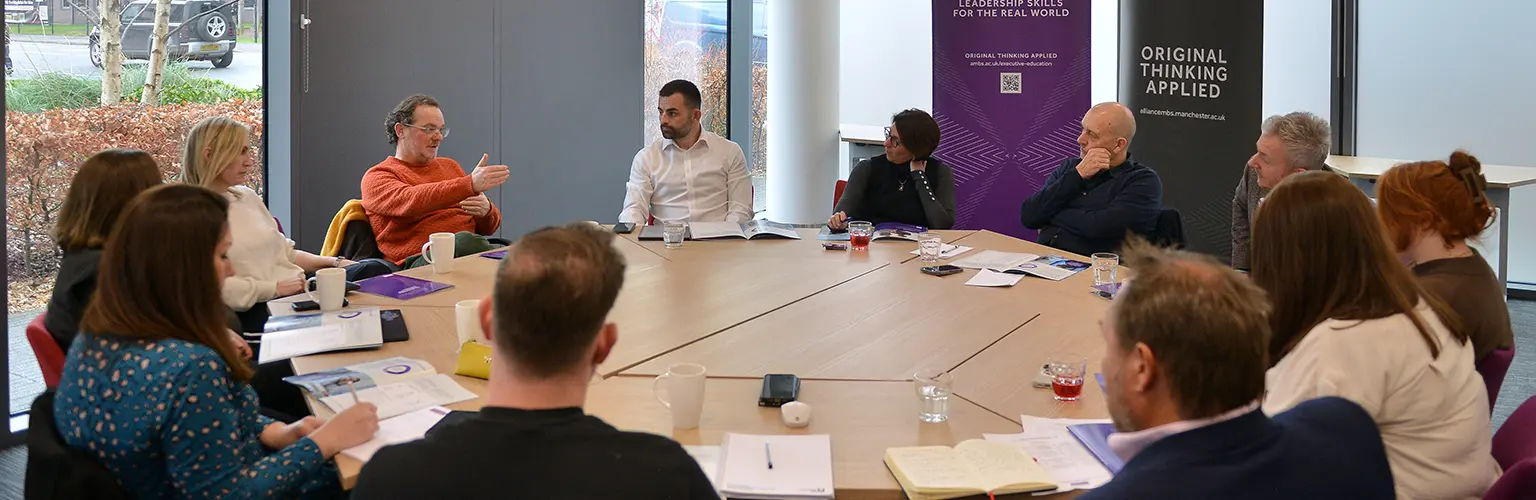
At a recent roundtable hosted here at Alliance Manchester Business School in partnership with TheBusinessDesk.com, the conversation among leaders from technology, finance, infrastructure, communications and talent management pointed towards a significant challenge: how leaders make strategic decisions when the environment around them is constantly shifting.
Technology may be accelerating the pace of change, but the real leadership challenge lies in strategy, capability and human judgement.
When strategy becomes harder to define
Strategy has always been about making choices about the future but increasingly those choices are being made with far less certainty.
As Mark Healy, Professor of Strategic Management and Head of the Innovation Division at AMBS, noted during the discussion:
“Strategy is about making choices about the future. But it becomes much harder when the assumptions you’re making about customers, competitors or even how industries work may change very quickly.”
There’s no doubt that AI has amplified this uncertainty and in some sectors it is already transforming workflows and business models, while in others its long-term impact is still unclear.
For leaders, this means moving away from rigid long-term plans towards more adaptive approaches to strategy, including scenario planning, continuous reassessment and faster decision cycles.
Technology lowers barriers and intensifies competition
Another theme emerging from the roundtable was the way technology simultaneously creates opportunity and pressure.
Digital infrastructure, AI tools and platforms have dramatically lowered the cost of building new products and services. While this creates opportunities for innovation, it also means competitive advantages can disappear faster than before.
The implication is that technology alone rarely creates sustainable advantage. Instead, organisations need to think carefully about how technology reinforces their core value proposition, rather than assuming it is the solution in itself.
The AI adoption paradox
While organisations have unprecedented access to powerful digital tools, many are struggling to realise meaningful value from them.
Participants highlighted a familiar pattern: businesses adopting multiple technology platforms but seeing low usage and unclear return on investment.
A common barrier is fragmented data. When information sits in disconnected systems, even sophisticated AI tools struggle to produce useful insights.
This creates what several participants described as an AI adoption paradox: technology is widely available, but organisations lack the internal capabilities, governance structures or data foundations needed to use it effectively.
In practice, the challenge is often less about the technology and more about leadership capability, organisational learning and change management.
Talent, skills and the changing workforce
Technology is also reshaping the skills landscape. In technical sectors such as engineering and infrastructure, automation has made advanced tools more accessible, but it has also created new capability gaps.
Several participants highlighted the growing challenge of employees who are proficient with software but less confident with the underlying fundamentals.
At the same time, industries from construction to telecommunications continue to struggle with shortages of skilled workers.
The discussion highlighted a widening skills mismatch: shortages in critical technical roles on one side, while many younger people struggle to access clear career pathways on the other.
Governance in an unpredictable environment
For treasury and risk specialists at the roundtable, volatility is no longer an exception, it is the baseline.
From commodity price fluctuations to geopolitical disruption, organisations must increasingly make decisions in rapidly changing conditions.
One response discussed was the importance of clear governance frameworks that allow teams to act quickly, rather than waiting for decisions to move slowly through organisational hierarchies.
In other words, resilience depends not only on strategy, but also on decision-making structures that allow organisations to respond effectively to uncertainty.
Human judgement in a technology-driven world
A final theme covered was the importance of authenticity and human leadership in an increasingly automated environment.
As AI-generated content becomes more widespread, audiences are becoming more sensitive to credibility and expertise. Whether communicating internally or externally, leaders need to demonstrate clear perspectives and genuine knowledge rather than relying on generic messaging.
As Professor Eunice Maytorena-Sanchez, Senior Lecturer of Project Management at AMBS, observed during the discussion:
“Organisations are investing heavily in transformation, but many recognise the pace of change is still slower than the environment around them. The challenge is not only adopting new technologies, but building the capabilities and ways of working that allow organisations to adapt and innovate continuously.”
In this sense, technological disruption is reinforcing the importance of distinctly human capabilities:
- Critical thinking
- Judgement
- Communication
- The ability to guide organisations through change
Preparing leaders for continuous change
Technology is accelerating transformation across industries, but the capabilities that matter most remain deeply human.
For organisations navigating a VUCA world, success may depend less on predicting the future and more on building the capability to adapt as conditions evolve.
For leaders looking to strengthen their ability to navigate this complexity and make confident strategic decisions, we offer a range of short business courses designed to build practical skills in areas such as strategy, leadership, digital transformation and innovation.