
From research to real-world impact in intermodal freight
Through a portfolio of AI-powered solutions, AMBS is helping decarbonise the logistics freight industry.
The maritime sector underpins national logistics networks and global supply chains, yet it faces increasing pressure to decarbonise while maintaining efficiency, safety, and competitiveness.
Researchers Dr Arijit De, Prof. Yu-wang Chen and Prof. Richard Allmendinger are addressing this challenge through a portfolio of AI-powered solutions for intermodal freight logistics operations. These innovations move beyond theory to deliver real-world operational and environmental impact, supporting industry partners and policymakers in the transition towards net-zero logistics systems.
Dr De, Associate Professor of Management Science at AMBS, is leading the impact study. Working closely with ferry operators, ports, and logistics providers, the research focuses on AI-augmented decision-making, operational optimisation, and emissions reduction across ports, ferry routes, and wider maritime logistics and intermodal supply chains.
AI at the point of impact
Several AI-augmented digital applications developed by AMBS researchers have progressed beyond proof-of-concept into operational pilots and early commercialisation discussions, aiming to deliver measurable efficiency gains and emissions reductions across maritime freight and intermodal logistics systems.
A flagship innovation is the real-time vehicle loading optimiser for ferry operator DFDS on the Dover to Calais and Dover to Dunkirk corridors. This AI solution dynamically optimises vehicle loading, sequencing, and vessel turnaround by integrating real-time traffic flows, vehicle mix, port capacity constraints, and sailing schedules.
By reducing idle time and improving vessel utilisation, the system cuts fuel consumption and emissions on one of Europe’s busiest maritime routes, while improving service reliability, punctuality, and port throughput.
This AI-powered ferry decarbonisation and emissions optimisation platform unifies operational decision support with strategic modelling, using English Channel data to help operators, ports, and policymakers evaluate how fleet configuration, turnaround strategies, energy technologies, and fuel choices affect emissions, cost, and service performance.
The system enables robust ‘what-if’ analysis across traffic, weather, and regulatory futures, strengthening the business case for clean energy investment and smarter scheduling, while extending to AI-driven voyage and energy optimisation for multi-fuel vessels through continuous adaptation to weather, renewable generation, battery performance, and vessel behaviour.
Digital twin
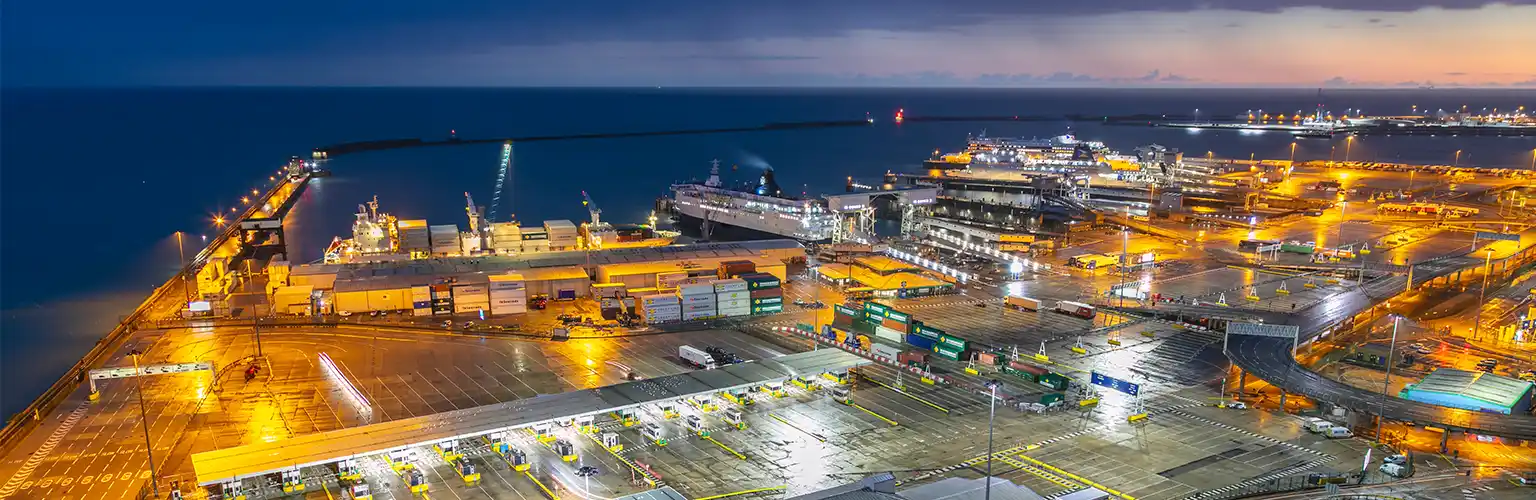
Matching this ‘at sea’ capability, researchers have also developed an AI-augmented ‘digital twin’ for the landside operations of Port of Dover, which predicts traffic demand in real time and dynamically allocates traffic lanes, improving terminal throughput and reducing congestion. It embeds AI as a practical, end-to-end decision-support tool across port, vessel, and voyage operations.
Complementing this is maritime fuel forecasting research, which applies AI to predict future fuel prices for various international ports. This work provides an important foundation for improved fuel management, reducing bunkering cost (the cost of supplying fuel to a ship’s engines and machinery), and future integration of alternative fuels across maritime fleets.
Strategic asset
AMBS researchers are also developing AI-augmented digital twin capabilities as a longer-term strategic asset for the maritime sector. A key example is the AI-augmented digital twin of Dover Harbour, developed in collaboration with the Port of Dover. In 2024 this work led to Port of Dover and the University of Manchester being awarded a £333,585 grant from Innovate UK, supporting a three-year Knowledge Transfer Partnership (KTP).
Led by Professor Chen as Principal Investigator, with Dr De as Co-Investigator, the project demonstrates future potential to enhance navigational safety, scheduling, and port resilience.
Investment
Dr De says with several tools entering commercialisation discussions, and others forming a strong pipeline for future impact, this research demonstrates how AI can enable operational excellence while supporting sustainability goals. “Our work is helping to position the UK as a global benchmark for AI-enabled, low-carbon intermodal logistics operations.”
He says the work also highlights the need for supportive regulation and infrastructure investment. “Regulations must enable ports to monitor emissions using real-time data, electrify facilities, and adopt alternative fuels. Clear guidelines are essential to encourage innovation while ensuring environmental and operational targets are met.”
He also points to the importance of expanding alternative fuel bunkering, electric vessel charging, renewable energy generation at ports, and funding for retrofitting older vessels with green technologies. “Greater emphasis is now also required on deploying impactful AI-enabled solutions at scale through data sharing and coordinated policy frameworks.”
Added Professor Chen: “This project emphasises the value of collaboration. Partnerships with Port of Dover and industry have enabled interdisciplinary expertise to be applied to real business challenges and logistics digital transformation.”
Research funding
The research has been enabled by significant funding from across the UK research and innovation landscape. To date, £672,113.84 of funding has been attracted by Dr De as Principal Investigator to AMBS. Funding has been secured through various research agencies, the breadth of which signals strong confidence in the scalability and real-world value of AMBS’ AI-augmented intermodal freight logistics solutions.
Funders have included:
- Horizon Europe, Simon Industrial & Professional Fellowship
- EPSRC/ESRC Impact Acceleration Accounts, Department for Transport, and Connected Places Catapult
- Humanities Strategic Investment Fund
- EPSRC – DfT Wave 2 Flex Fund through UK Clean Maritime Research Hub
- Innovate UK through the Turing Innovation Catalyst Manchester
- EPSRC Catapult Network Innovation Launchpad Network+
- UKRI Impact Acceleration Accounts spanning AHRC, EPSRC, and ESRC.