
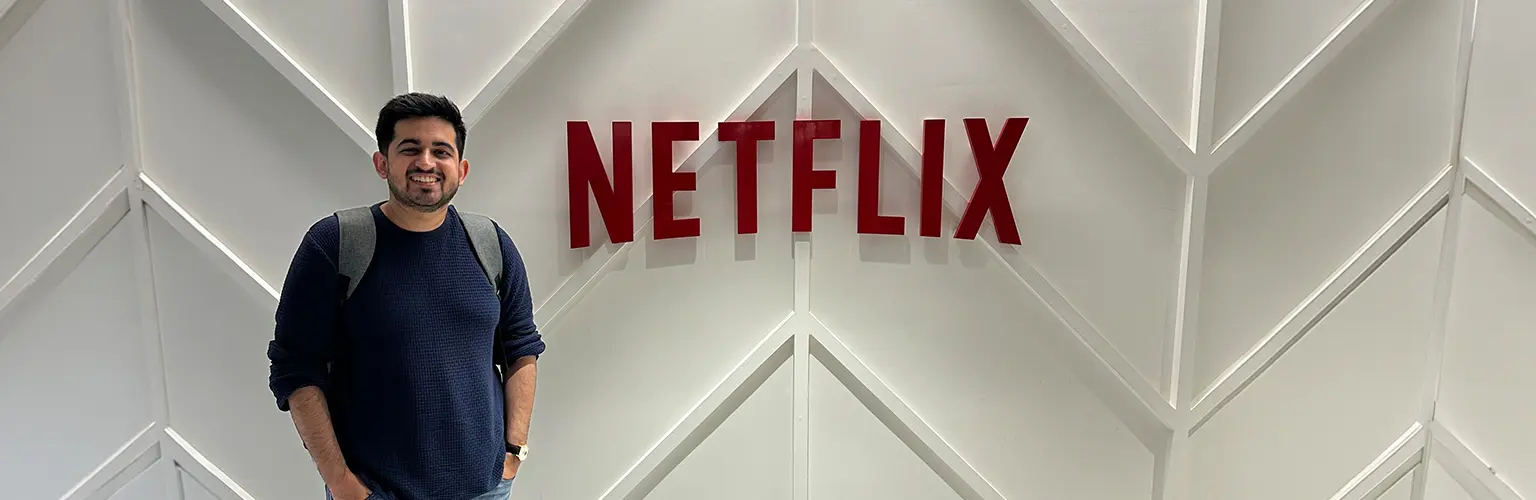
Rewriting a career path through the MBA
After working on India’s first Netflix original show and contributing to major global platforms like IMDb, Armaan Raj Dua stepped out of the entertainment industry and into the Manchester MBA.
His career is anything but typical. Before business school, Armaan was already working behind the scenes of global entertainment — collaborating with internationally acclaimed directors and helping grow Netflix’s YouTube presence to tens of millions of subscribers.
Now at Manchester, he’s adding strategy to that creative edge, building the tools to turn ideas into ventures.
We caught up with him to find out more about his unconventional career trajectory, and why Manchester was his best next step.
You worked on India’s first Netflix original show. What was that experience like?
So my career originally began as a Production Intern at a production company. I worked on a show I'd watched and loved, Sacred Games, Netflix's very first original in India. I got to work with two Indian directors, Neeraj Ghaywan and Anurag Kashyap, with extraordinary filmographies whose work has screened at Cannes and earned recognition far beyond India.
The hours were gruelling, and there were days I was running on two or three hours of sleep. But that was a choice I was making willingly, because I wanted to learn as much as I possibly could. Shooting entirely on live locations across Mumbai meant real streets, real neighbourhoods, no controlled environments, just the city as it actually is. Dharavi was one of those locations – one of the world's most densely populated neighbourhoods, with an energy and complexity that simply can't be manufactured.
No two days looked the same, and there was rarely a clear playbook; you had to find your footing quickly, make decisions with incomplete information, and grow comfortable with uncertainty.
Looking back, that might be the most valuable thing I took from the experience: the ability to operate without a map. It's something I've drawn on and gravitated towards ever since.
What did working on Sacred Games Season 2 teach you about leadership and operations?
The aspect that surprised me most was how much of filmmaking is, at its heart, a feat of intricate operations.
Two directors, each with their own distinct creative vision and way of working, whose separate story tracks had to ultimately cohere into a single, seamless world, and an entire production machine that had to serve both, simultaneously.
You have actors inhabiting complex characters, crew members across dozens of departments, all of whom need to be in the right place, with the right things, at the right time. My job was to hold that together: coordinating across all of it, anticipating what people needed before they had to ask, and creating the conditions for the creative work to breathe.
Working directly with Neeraj Ghaywan and Anurag Kashyap, directors who are uncompromising in their vision, taught me that the best operational leadership is almost invisible. When it's working, nobody notices it. People feel free, resourced, and trusted to do their best work.
What I carried from that experience was a particular idea of leadership: not direction from above, but service to the people around you. The goal is never to be the most visible person in the room: it's to make everyone else more effective. That's shaped how I've tried to lead in every role since.
After working in film production, you transitioned into marketing which eventually led you to work for Netflix internally. How did that transition happen?
My original ambition was to write and direct films, and that's what brought me to the sets of Sacred Games in the first place.
After this, I joined The Glitch, an advertising agency, which gave me a version of that: writing and directing content for brands, just in shorter form. And in a strange full-circle moment, my first brief was to market Sacred Games itself: we'd just won the Netflix retainer.
Somewhere in that work, my focus began to shift. Along with being occupied with creating something meaningful, I was fascinated by how it found an audience. How attention works, what makes people stay, why some messages travel and others don't. That curiosity pulled me towards marketing, and eventually to Netflix, where I could explore it at a scale I hadn't anticipated. The path wasn't planned, but each step was following the same instinct.
You grew Netflix’s YouTube channel to 17-18 million subscribers. What was your strategy?
The foundation was laid during my time at The Glitch, where we were already working on the channel in its early days, so when Netflix invited me to join internally (while I was on a shoot!) felt like a natural continuation rather than a leap.
The core strategic question was simple but not easy: how do you make a global entertainment brand feel genuinely local? Netflix had extraordinary content, but content alone doesn't build a relationship with an audience. We were among the first in India to do creator partnerships at real scale: bringing in local voices to tell global stories through a distinctly Indian lens, with all the cultural nuance, humour, and reference points that come with it.
What I now know, since the MBA, is that we were operating in a ‘blue ocean’: uncontested space, no direct competition. Nobody else was doing this with the same intentionality or scale. When that approach clicked, the work followed.
We made many videos that trended, and there's something uniquely gratifying about seeing your work become pop culture: a joke, a format, a moment that people reference in everyday conversation. That only happens when a team is genuinely aligned around a vision and given the trust to execute it.
As someone from the creative industries, why did you pursue an MBA?
I have reached a juncture where I know that I want to build something of my own, and that ambition forced me to be honest about what I actually understood. Marketing and sales felt like home turf.
But the rest of a business – finance, operations, how an organisation actually scales – was more of a black box. I'd spent years inside large companies where those functions hummed along around me, but they were never really mine to understand or appreciate. I'm someone who loves going from not knowing something to knowing it well. That process genuinely excites me.
The MBA felt like the most rigorous way to open that black box. I wanted to learn it properly, not just absorb it by accident.
Why did you choose the UK?
The UK felt like the right call for reasons that only became clearer over time.
The 15- or 18- month format of the Manchester MBA was a genuine draw: intensive, focused, no filler. I'd looked at longer programmes around the world, but I didn't want to press pause on my life for that long. I wanted to immerse myself fully, come out sharper, and keep moving.
There was also something about being in Europe that appealed to me personally, the exposure to different cultures and ways of thinking, a network that isn't confined to one market. And then there was Manchester itself, which I hadn't anticipated. It has an energy that's hard to put your finger on: restless, young, unapologetically itself. I recognised something of myself in it, and that mattered more than I expected.
Why did you choose AMBS?
What drew me to AMBS was the Manchester Method: learning by doing, real problems, live consultancy projects.
I've always grown more by immersing myself in real-world application rather than abstractions, and here was a programme built around exactly that. The cohort sealed it: students from 27 countries, genuinely diverse in background, industry, and perspective.
The students you're in the room with are as much a part of the education as anything on the syllabus, and at AMBS, that room is remarkably rich. The pedagogy, the teaching style, the kind of operator the programme seems designed to produce. It all pointed in the direction I wanted to go.
The Merit Scholarship, when it came, felt like confirmation that the fit went both ways.
How has your MBA experience been so far? Has there been a specific module that changed your thinking?
The MBA has been more challenging and more rewarding than I expected, often simultaneously.
Three modules have shifted my thinking in particular. Corporate Finance challenged the way I read a business: understanding valuations, capital structure, and how money actually moves gave me a lens I simply didn't use before.
Strategy and Competition brought a different kind of rigour; drawing on cases from businesses around the world, it has sharpened how I think about why some ideas win and others don't.
And Leading Global Transitions reframed something I'd always cared about instinctively: how organisations genuinely move toward becoming more responsible and sustainable, rather than just professing it.
Outside of lectures, I'm the President of the Consulting Club. I play football, and have joined the AMBS band (amongst quite a few other activities). I've played guitar for years, so that was an easy yes. I've also kept up with photography and filmmaking, which have always been as much a part of me as my professional pursuits.
What have you experienced in the MBA so far that you can apply immediately to meet your future goals? What experiences are you looking forward to?
The frameworks from Strategy and Corporate Finance are already shaping how I think about the business I'm developing: evaluating a market opportunity, stress-testing a model, thinking about competitive positioning with real rigour.
Things that were instinctive before now have more structure behind them. The global immersion and live consultancy projects have been exactly what I hoped for: theory meeting real, messy problems, which is where I learn best.
What I'm most looking forward to is deepening my engagement with the Masood Entrepreneurship Centre, being surrounded by people who are building things, with access to the mentorship and resources to do it properly, is exactly the environment I want to be in as I work on the venture I’m building.
What kind of business are you envisioning?
Three things, really. The most ambitious is building a lifestyle brand from the ground up, moving into manufacturing. It’s an industry I haven't worked in before, but one I'm approaching with the same curiosity I've brought to every new chapter. I’ll continue working with brands on their business and marketing presence, combining the creative instincts I've built over the years with the strategic and financial rigour I'm gaining at AMBS.
And I want to work alongside my father in his warehouse and logistics business back in India, which is something I can now contribute to in ways I couldn't before. All roads lead back home. Beyond that, I'm leaving room for serendipity. Some of the best things in my career were things I couldn't have planned, and I'd like to stay open to that.
How is the MBA preparing you differently compared to your previous experience?
My previous experience kept me moving. There was always a next campaign, a next launch, a next problem to solve. What the MBA has given me is something I didn't realise I was missing: the space to pause, reflect, and actually sit with what I'm learning. I find myself going beyond the classroom, forging my own path through concepts that interest me, following threads I wouldn't have had time to pull on before.
What makes it richer is having years of real experience to bring to it. I can contextualise what's being taught, connect it to decisions I've made, and see my own past with a new lens. It's a strange and valuable thing, to study something and simultaneously re-understand your own history through it.
If someone in the entertainment industry is considering an MBA, what would you tell them?
I'd highly recommend it, but the timing matters. I think the MBA is instrumental when you've got enough experience to know what you don't know. Too early and the case studies and frameworks may float above your reality without landing. If you go after years of doing the work like running campaigns, managing budgets, leading teams, making things, you bring real questions to the programme, and the learning is much more pointed.
The entertainment industry has a tendency to treat business education as something for people who couldn't make it on the creative side. I think that's exactly backwards. The most effective people I've encountered are the ones who can hold both: develop a creative vision and understand why it makes financial sense, who can inspire a room and then think seriously about how to make it viable.
In an industry that's changing faster than ever, that combination isn't merely useful, but absolutely necessary.
Find out more about how the Manchester Full-time MBA can support your professional goals >>