
Why I chose Alliance Manchester Business School
Before coming to the University of Manchester to pursue my master’s degree, I had around one year of professional experience working in human resources. Interestingly, my undergraduate background was not in business but in education. It was only after stepping into the workplace that I discovered my growing interest in HR.
Through hands-on experience, I began to realise how closely HR work is connected to organisational culture, employee wellbeing, and long-term business success. This realisation encouraged me to pursue a master’s degree overseas, where I could strengthen my professional knowledge, improve my English skills, and gain an international perspective.
Application process
I started preparing my applications around October and November, researching different universities and comparing HR-related programmes across the UK. During this period, I spent a lot of time carefully reviewing course structures, teaching approaches, and student support systems. I received my unconditional offer from the University of Manchester’s Alliance Manchester Business School (AMBS) in early December, and the overall application process felt smooth and efficient.
Whenever I had questions, I could easily contact the admissions team via email and received prompt and helpful replies. This responsiveness made me feel well supported and increased my trust in the university, especially when planning important next steps such as my visa application and accommodation.
A warm welcome
Objectively, one of the main reasons I chose AMBS was its strong reputation. As one of the top business schools in the UK, AMBS is highly regarded internationally and offers extensive academic resources alongside a strong global alumni network. Compared to London, Manchester also has a relatively lower cost of living, making it a more affordable option for high-quality education. From a practical perspective, the location was another major advantage. The university is based in Manchester city centre, with excellent public transport connections and an airport only around 20 minutes away by car. For an international student, this level of convenience was extremely reassuring.
On a more personal level, what truly stood out to me was how welcomed and valued I felt even before arriving in Manchester. After receiving my offer, AMBS organised a number of online talks and programme introduction sessions, which gave me a clearer understanding of the course and allowed me to hear directly from staff and current students. These sessions made the university feel approachable and student-focused, and they played a significant role in my final decision to choose AMBS.
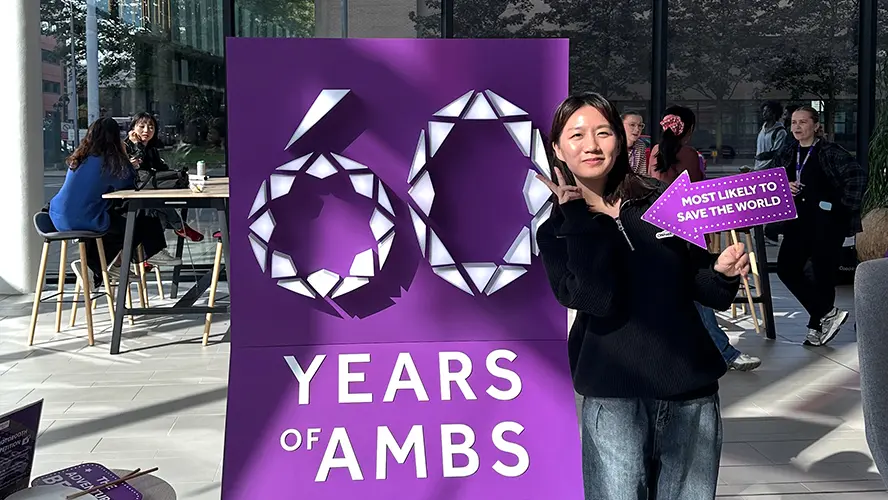
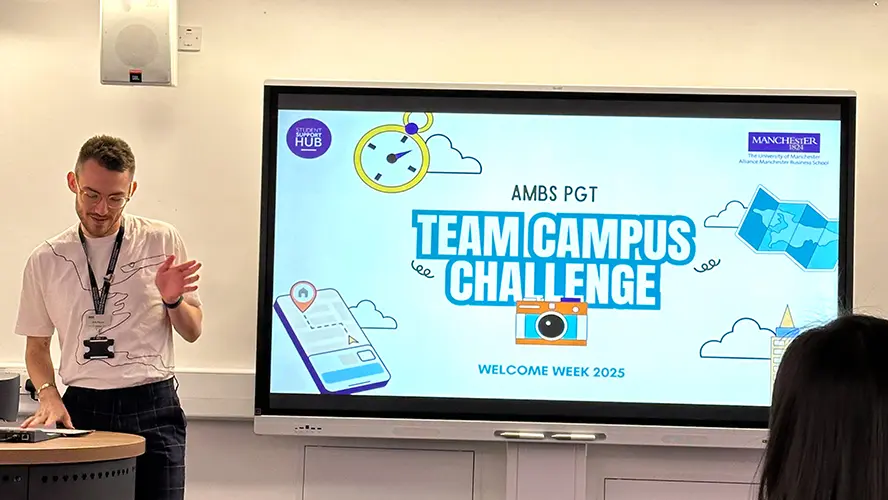
I still remember arriving on campus during Welcome Week; the atmosphere was lively and exciting. There were stalls from various student societies and university organisations, which made it easy to explore different interests and get a sense of the vibrant campus culture. Our programme also organised workshops and team-building activities before classes officially began. These sessions helped us familiarise ourselves with the learning environment, settle into university life, and start building friendships from the very beginning.
Support for international students
As a non-native English speaker, I initially had some concerns about adapting to academic life in the UK. However, the University of Manchester offers a wide range of support services designed to help international students thrive. These include free academic English workshops, academic skills sessions run by the library, career development support, and mental health resources.
One of my favourite workshops was the Academic Writing Support, run in collaboration between the university library and the Royal Literary Fund. The one-to-one sessions allowed me to ask specific questions about essay writing and receive clear, practical feedback. This support significantly relieved my concerns about my academic writing skills and boosted my confidence. Beyond academic development, these workshops were also great opportunities to meet students from different programmes and form new connections.
Hands-on learning
Within the MSc Human Resource Management and Industrial Relations programme, some modules are shared with students from the International Human Resource Management course. Through seminars and group discussions, I have had the chance to exchange ideas with classmates from diverse cultural and professional backgrounds. One of the most memorable learning experiences so far has been the Simulated Collective Bargaining Exercise. Based on a real-world case, we role-played as train drivers’ unions and UK train operators, negotiating working conditions and agreements.
This experience helped me develop stronger negotiation and communication skills and gave me a better understanding of different stakeholder perspectives. In Semester 2, I hope to apply these skills by contributing more confidently to seminars and group discussions, particularly when dealing with complex or sensitive topics. They will also be valuable for my final year dissertation, where I will need to explore employment relations issues critically and take different perspectives into account.
Transformative
Looking back, my journey at the University of Manchester has been both rewarding and transformative. The supportive academic environment, friendly staff, and diverse student community have made it easy for me to settle in and find my place here. If you are considering studying abroad and looking for a welcoming environment where you can grow academically, professionally, and personally, AMBS might just be the right place for you — and perhaps I will see you in Manchester.