
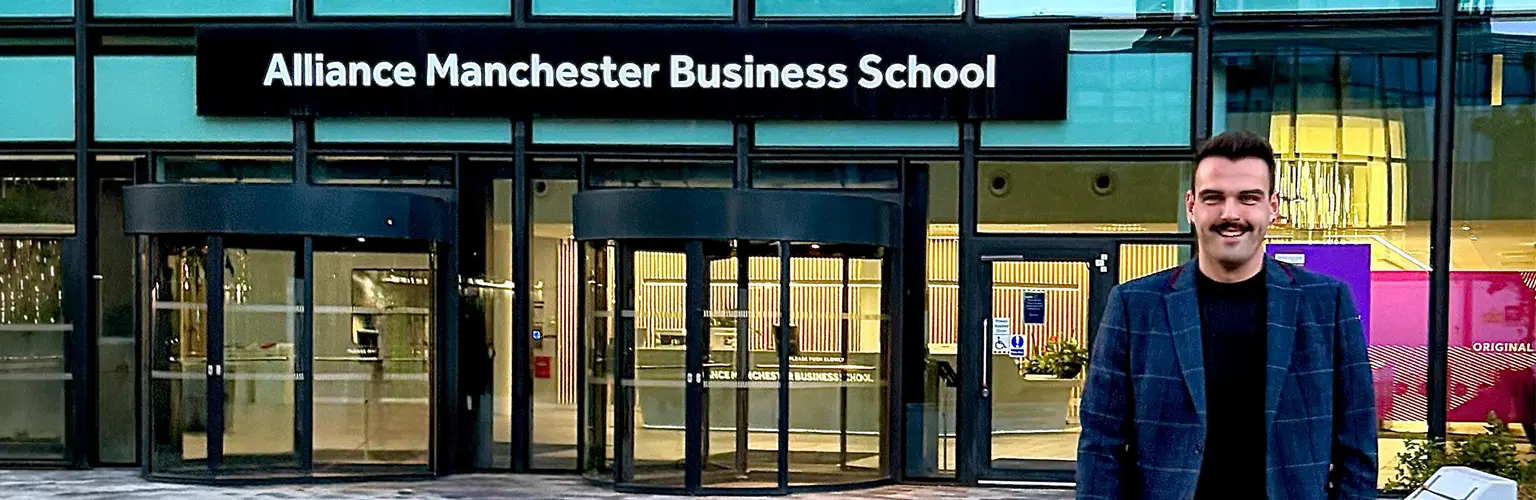
After building a career in the NHS, Samuel Mapplethorpe-Walters explains why he chose to study MSc Financial Management and why the degree is important for professionals in careers beyond finance.
For many working professionals, finance can feel like a closed world reserved for specialists.
If you did not see yourself as a ‘numbers person’ at school – or chose not to study finance, mathematics or another STEM subject at university – it can be easy to assume that route is no longer open to you.
Samuel Mapplethorpe-Walters’ story proves this assumption isn’t true.
Recently, we spoke to him about his background in operations at the UK’s National Health Service (NHS), what led him to study MSc Financial Management, and what it has been like to approach the subject without a traditional finance background.
Tell us more about your personal, educational and professional background to date. How did you end up in your current role as a manager for the NHS?
My background hasn’t followed a conventional path, and I think that’s shaped a lot of who I am professionally.
After my GCSEs, I initially pursued a music qualification before deciding to self-study A-Levels, although I eventually changed direction again. Looking back, those early decisions taught me a lot about being willing to adapt when something no longer felt right.
I later completed a first-class BA (Hons) in Educational Studies and Psychology at Bishop Grosseteste University in Lincoln. During my degree, I started working in the NHS in Children and Young People’s Mental Health Services, supporting young people to access the most appropriate therapeutic support. What began as an entry-level role gradually developed into a long-term career.
Over the past nine years, I’ve progressed into more senior positions, and I now work as one of the senior members within my team, with responsibility for staff oversight and supporting the operational delivery of the service.
Alongside this, I completed a funded postgraduate certificate in Transformational Change last year, which further strengthened my interest in leadership, strategy, and organisational development.
My experiences across healthcare, leadership, and service transformation have increasingly pointed in one direction toward the financial and strategic side of how organisations make decisions.
The MSc felt like the natural next step, not a departure from what I'd built, but an extension of it.
Do you think financial understanding is becoming more important across different industries and roles? Why?
Yes, genuinely. And I think the reason is that financial decisions touch everything in an organisation: resourcing, strategy, staffing, growth. They always have, but for a long time the assumption was that understanding those decisions was someone else's job. I think that's changing.
What I've seen through my career is that the people with the most meaningful contributions to those conversations aren't always the ones with a finance background; they're the ones who understand the operational reality and can translate that into financial terms. That combination is where the real value is, and I think more industries are starting to recognise it.
For individuals, even a basic understanding of how money moves through a business changes how you work. You ask better questions, you understand why certain decisions get made, and you're better placed to make a case for the things you care about.
It's not about becoming a financial expert. It's about not being disconnected from one of the most important parts of how any organisation functions.
Why are you interested in making a career pivot into finance?
Finance is fundamentally about decision-making and helping individuals, businesses, and organisations figure out the best way to use what they have to get where they want to go. That's what draws me to it. It's not abstract; it's deeply practical and requires problem-solving with confident analysis.
I came into the NHS through circumstance rather than intention, but what I found there was that I was good at exactly that kind of work: sitting with someone in a high-pressure moment, helping them think clearly, earning trust quickly. I've spent nine years doing that in a regulated, client-facing environment. And alongside it, I'd naturally find myself drawn to the financial side of things – helping friends, family, colleagues understand financial decisions, how certain businesses operate, how to make money work harder. Never formal, just consistent.
The pivot is really about going back to where my natural strengths lie. The MSc in Financial Management has been the turning point, giving structure and credibility to something that was already there.
Before starting the programme, what assumptions did you have about finance? Did you have any hesitations about studying it?
Honestly, I didn’t fully know what I’d signed up for. I knew that studying finance and this programme would be a fantastic step towards where I wanted to take my career and would give me a much broader understanding of the financial sector.
However, I did have a sense it would be more maths and balancing budgets rather than the fascinating depth of analysis and theoretical understanding that comes with it. My main hesitation was balancing the self-study alongside a full-time job; however, the adjustment didn’t take long and was definitely worth it.
What made this the right time in your career to return to education?
I've dipped in and out of education my whole career and never fully lost touch with it. But there's a difference between keeping the idea alive and actually committing to it, and for a long time I was better at the former.
The timing came down to a few things converging. Having realised that a move toward a more corporate and strategic field felt more naturally aligned, it felt like the right moment to stop studying topics that only benefited where I already was and actually invest in where I wanted to go.
As my career stabilised and became easier to manage day to day, the challenge of returning to education in a completely different field was given the space to be meaningful rather than just another pressure.
Personally, life had settled in a way that created genuine space for it, and I reached a point where I'd run out of good reasons to keep deferring it. I'd always told myself an MSc was something I'd do eventually. Eventually has a way of never arriving. Having the stability and support around me to actually commit made it a decision rather than a daydream.
Why did you choose AMBS as opposed to other financial management master’s programmes?
The biggest draw was that the programme is designed for people without a prior background in finance. As someone whose degree is in Educational Studies and Psychology, that mattered. A lot of programmes in this space screen you out before you've had a chance to demonstrate what you bring; AMBS doesn't do that. The course builds from foundational concepts upward, which means the entry point is accessible without the content ever feeling dumbed down.
A qualification from The University of Manchester carries real weight across industries, and that credibility was important given I'm making a significant career transition, so it needed to mean something to the people I'd be presenting it to.
The Manchester location was also practical and manageable alongside full-time work, which made the in-person elements feel like an asset rather than a logistical problem.
Honestly, I didn't spend long weighing up alternatives. Once I understood what AMBS was offering and who it was designed for, it was a straightforward decision.
What’s your favourite thing about your experience on the programme?
My favourite part of the programme, contrary to my initial expectations, is the in-person workshops. The workshops bring the course content to life and create opportunities to learn from both the course leaders and other students.
Plus, it is great for networking and meeting people from different parts of the world in different industries who all bring different professional experiences. Through that, I’ve learned a lot about how various industries operate but also been given the opportunity to work with others as part of the group assignments.
While it’s a lot of work in a short few days, the overall understanding of the course content is amplified through these group projects. As someone who usually recoils at the mention of networking, I must say this has been the best part for professional and personal development.
What’s something about finance that turned out to be very different from what you expected?
I honestly expected there to be a single ‘right answer’ to most things in finance. In some areas there are clear technical answers, but what surprised me was how much interpretation, judgement, and context can influence financial decision-making.
Different assumptions, priorities, risk appetites, or organisational goals can all lead to different recommendations, even when people are working from the same information. That was something I hadn’t fully appreciated before starting the programme.
What advice would you give to working professionals who are interested in finance but feel intimidated by the subject?
Honestly, it hasn't felt as overwhelming as I expected, and I think that's the point. There's an enormous amount to know in finance, but there's no expectation to know all of it at once. The learning is gradual, and if you have a genuine interest and drive that journey is really engaging rather than intimidating.
The thing that helped most was focusing on one topic at a time rather than trying to grasp finance as a whole. It's a big subject, but it's made up of smaller, digestible pieces, and each one builds on the last. Formal education also helps because a structured programme takes a lot of the intimidation out of the process. You're guided through it in a logical order, and there's always someone to help when things don’t make sense.
I'd also say that finance isn't just for people pursuing a career in it. Any working professional, regardless of their role or industry, will benefit from understanding even a small part of how money moves through a business. It makes you a better thinker, a better colleague, and a more informed decision-maker. The intimidation tends to disappear pretty quickly once you realise how applicable it all is.