
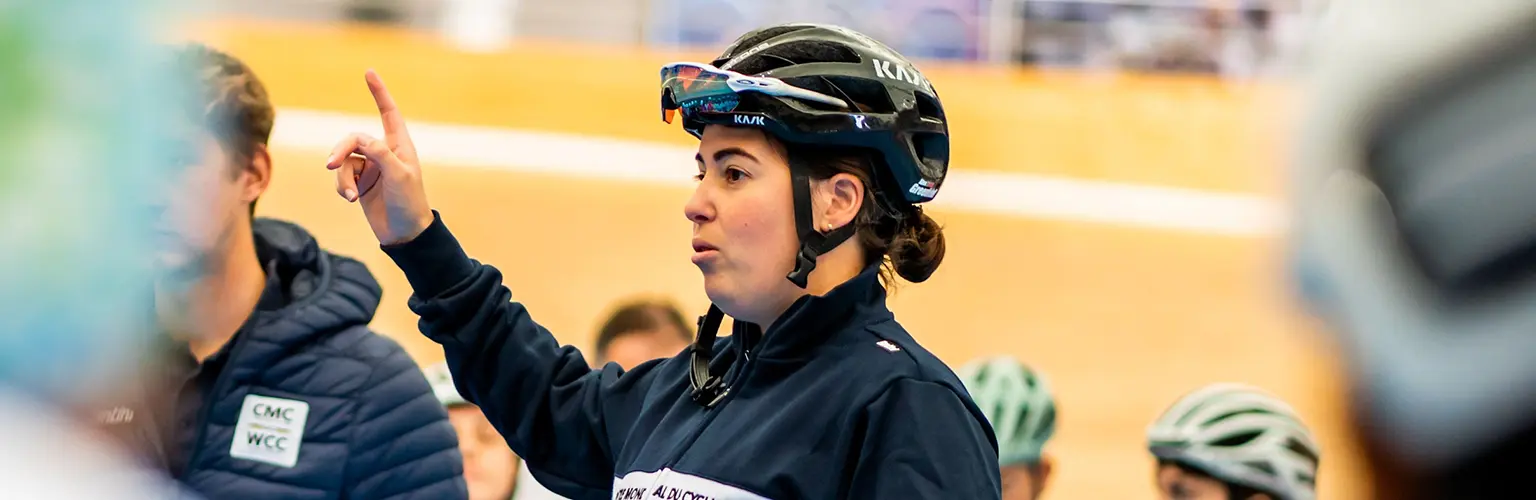
Alex Greenfield, Full-time MBA candidate at Alliance Manchester Business School, built her career in women’s cycling.
In this article, she reflects on the lessons that led her to pursue an MBA.
1. Leadership means making decisions before you feel ready
Elite sport teaches you a lot about yourself very quickly.
In professional cycling, decision-making happens in fractions of a second. In fact, seconds are often too slow. Hesitation is how you lose races.
You learn to trust your gut, commit to the initial decision, and only once you're 'in the breakaway' you can reflect, zoom out, and appraise the situation properly.
Miss the winning move and you can analyse it, but you can't change the outcome. Usually, hesitation equals losing or being out of the race.
What surprised me when I moved closer to the business world is that decision-making is almost the opposite. You often have more time, more information, and frameworks to support your thinking.
In sport, you train yourself to speed up. In business, you often must learn how to slow down. But I believe slowing down is easier to learn than speeding up.
That transition, from instinct-led decisions under pressure to structured and reflective leadership, is one of the reasons an MBA made sense to me.
2. Self-awareness is the foundation of great leadership
Leadership qualities, both in sport and in business, starts with looking inward. You must be willing to challenge your own views and assumptions.
I often think of Brené Brown’s work when I reflect on leadership: the idea that good leaders are vulnerable, and that leadership is a constant learning journey.
You're always walking this fine line between being open and human, while also being confident and persuasive enough that people will follow you.
You don't become a leader by having all the answers. You become a leader by being willing to grow.
3. The best leaders build trust, and pass it on
The most impactful lesson I learned about values-based leadership came when I was mentored into my first leadership role.
I remember the words clearly. My mentor said: "I'm asking you to do this role because I trust you. I trust you to make the right decisions for the team, to consider the options, and to take us in the direction we need. You don't need to check every small detail with me, you’ll learn as you go. I trust you."
That feeling of trust stayed with me. It shaped the kind of leader I wanted to be. I try to pass that on, to let people feel trusted and competent.
Leadership isn't about perfection. It’s about chasing excellence and letting your values guide your decision-making.
For me, that means constantly working on myself, getting comfortable with being uncomfortable, and learning to stay calm when everyone else is frazzled. Calm creates clarity, and clarity allows you to stay three steps ahead.
4. Leadership pressure is real — and boundaries matter
Leadership brings responsibility, and with it, doubt.
In fact, doubt often increases with responsibility. There's a reason people say, "It's lonely at the top."
I've held a leadership role where the pressure to deliver and perform followed me home.
I was always available. Always on my phone. And in hindsight, that wasn't sustainable.
Over time, I learned the importance of boundaries. I realised that I do my best thinking outdoors: hiking, moving, stepping away. Outdoor space allows for ideation, and my return to work and interaction was about execution. As a future leader (hopefully!), I recognise the need to protect time, to think and see the bigger picture. I try to avoid short-term reactions; they're not good for the organisations we're responsible for.
Doubt and uncertainty go hand in hand with leadership. In my experience, the best leaders aren't the ones who crave power. They're often slightly uncomfortable with it.
But they have the skill set to handle uncertainty, to listen (both internally and externally) and to act with integrity.
5. Experience alone isn't enough. Frameworks accelerate your impact.
I started seriously considering an MBA when I stepped into my first senior leadership role as Head of Sport at Uno-X.
I had ideas, vision, and energy, but I kept asking myself whether there was a better framework for creating change. I was learning on the job, but I wanted to balance experience with theory.
That’s what drew me to AMBS. I'd heard about the hands-on culture – jumping into live projects, learn by doing, and that theory supports you rather than leads you.
I’m not an academic by nature, and the idea of exam-heavy programmes didn’t appeal to me. I wanted to get my hands dirty.
6. An MBA builds resilience as much as knowledge
If I’m honest, I had no idea what to expect from an MBA.
Two months in, I told my classmates it was the hardest I’d ever worked. They laughed, and that sparked some eye-opening conversations about culture, work ethic, and different ways of operating.
I was seeing people work 24-hour days. It was daunting at first. But you find your rhythm and my MBA has been resilience building. The skills required for senior leadership mean managing complexity, volume, and pressure. I’m learning when to say no, because saying yes to everything dilutes quality.
That’s something sport taught me: the importance of recovery. I try to apply the same thinking now. Prioritisation, boundaries, and knowing what truly matters.
7. You don’t need to feel ready to start an MBA
In truth, I probably wasn't.
But readiness isn’t about having everything figured out.
You're ready if you’re willing to be challenged, to build resilience, and to grow. Not just professionally, but personally.
If you can learn to say no, prioritise, and accept sitting in a room not really understanding the corporate lingo (if you're like me and come from a sports background). Then I would say you’re ready. If you have the right mindset, I genuinely believe anything is possible.
For women considering an MBA, especially those coming from non-traditional background: I’ve realised my experience is my strength.
Trust yourself and jump in. You won’t regret it.