
Leading with purpose
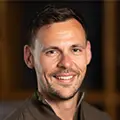
AMBS alumnus, Joel Oxberry (International Business and European Marketing class of 2009) supports veterans through employment, mental health, and care coordination services in his role as Deputy Chief Executive at UK charity, Walking With The Wounded (WWTW).
Alongside leading operational and strategic functions across the organisation, Joel has a particular interest in social value, culture and change management, and how purpose-led organisations can create systemic change.
We asked Joel some questions about his journey since graduation and his passion for social responsibility.
Could you describe any experiences at AMBS that influenced your career path?
Studying International Business and European Marketing exposed me to broader perspectives around how organisations operate across different cultures, economies, and social environments.
One of the things I found most interesting was the idea that businesses do not operate in isolation, they influence communities, behaviours, employment, and wider society through the decisions they make. The course encouraged a more rounded way of thinking about organisations beyond purely financial performance.
In truth, I hadn't really drawn the distinction between the two, but looking back, I think that early exposure influenced the way I approach leadership today, particularly within a purpose-led organisation.
How does your organisation embed social responsibility into everyday decision-making?
For WWTW, social responsibility is not a separate workstream, it is the reason for our existence. Every significant decision ultimately comes back to whether it improves outcomes for veterans and their families. That includes how we allocate resources, which partnerships we pursue, how we measure impact, and even how we design services. We increasingly focus on measurable outcomes and social value, not simply activity levels.
Are there any outcomes or changes that you are particularly proud of?
One area I am particularly proud of is WWTW's ability to deliver rapid access to mental health support for veterans. In a system where waiting lists can often be lengthy, we have built services that can intervene quickly and prevent issues from escalating further.
I am also proud of the organisation's growing focus on evidence and impact measurement. Charities are increasingly expected to demonstrate not only compassion, but effectiveness. I genuinely believe that WWTW is best-in-class in this aspect.
What challenges have you faced in trying to deliver socially responsible outcomes?
One of the biggest challenges is balancing rising demand with finite resources. Social challenges are often complex and long term, but funding cycles and organisational pressures can sometimes result in short-term thinking.
There is also increasing scrutiny around demonstrating impact, which is understandable and necessary, but measuring meaningful human outcomes is not always straightforward. Some of the most important changes, such as improved confidence, reduced isolation, or general wellbeing, are difficult to quantify neatly into an "outcome".
What role do you think business leaders have in addressing social or environmental challenges?
Business leaders have a significant role because of the impact organisations can have. Businesses shape employment, they affect communities, societal behaviours and create (or stifle) economic opportunity. Leadership today should look beyond financial performance to long-term responsibility.
I also think there is an increasing expectation from employees and customers that organisations contribute positively beyond profit generation. Social responsibility is not a branding exercise, it is an essential part of sustainable business.
How can organisations move beyond "tick-box" responsibility to meaningful change?
It's tough to draw a conclusion on a business from the outside. I believe that meaningful change starts when responsibility becomes embedded into decision-making rather than sitting separately in a report or campaign.
If social responsibility only exists within marketing material or annual reporting, people quickly recognise it as performative. The people that will see or feel this first are those closest to the business, and that will then spill out into the wider domain. How long that takes is hard to answer, but essentially, authenticity will always win.
What advice would you give to students or graduates who want to build social responsibility into their careers?
I would encourage people not to think of social responsibility as something limited to charities or the public sector. Every organisation and every role has the potential to create positive impact. My advice would be to stay true to your moral compass, keep curious, don't be afraid to ask difficult questions, and think critically about the wider consequences of decisions.
What's next for you or your organisation in this space?
One of the areas we are increasingly focused on is demonstrating our social value more clearly and consistently, particularly around veterans' mental health, and welfare support. I think organisations across all sectors will need to become better at evidencing impact, and we want to be ahead of the curve.