
Understanding employment relations in the real world
What does meaningful employee voice look like in practice? What happens when the priorities of employers and trade unions clash? And how will developments such as AI and wider social and political change shape the workplace of the future?
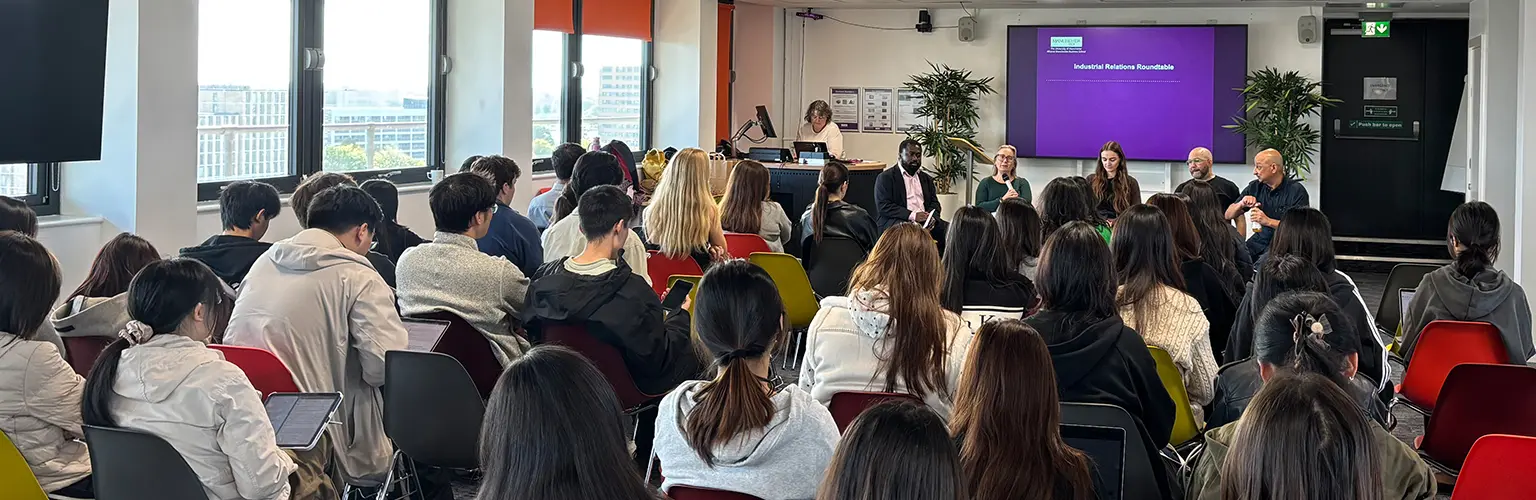
These were among the questions explored by students and panellists on our Human Resource Management course during a roundtable on Voice, Conflict and the Future of Work.
The session brought employer and trade union perspectives into the classroom, giving students the opportunity to hear first-hand how people working in employment relations navigate some of the same complex issues students explore through their studies.
Representing employers were Su Matthews, Head of Culture and Inclusion at Greater Manchester Combined Authority (GMCA), and Helen Spencer, Employment Relations Business Partner at GMCA Fire and Rescue. They were joined by Simeon Gill, representing UCU, and Ameen Hadi, representing UNISON. The discussion was chaired by Nathaniel Tetteh, Lecturer in Employment Studies.
Exploring different perspectives
Rather than presenting employment relations simply as employers versus trade unions, the discussion explored both the tensions and common ground between the two groups.
Employee voice was a key theme. The panel considered the different ways employees can make themselves heard within organisations, from trade union representation to staff networks, and the importance of creating environments where people feel able to speak up.
But employees having a voice is only part of the picture. As Helen and Su noted during the discussion, it is equally important for organisations to listen and respond meaningfully.
For student Adil Khan, hearing practitioners discuss the relationship between employers and unions first-hand challenged some of his expectations. Adil was surprised by the level of “cooperation between unions and employers”, noting that the session deepened his understanding of UK trade union relations from an international perspective.
The conversation also explored the realities of workplace conflict. Drawing on their own experiences, panellists discussed how factors including organisational culture, policy, accountability, workforce pressures and organisational change can contribute to disputes.
But the discussion also demonstrated that disagreement does not necessarily mean opposition. Early conversations, meaningful consultation, negotiation and attempts to resolve issues informally can all play a role in preventing conflict from escalating.
For Helen, effective consultation as a conflict resolution tool means going beyond a “tick-box exercise” and ensuring employees feel their views have been genuinely considered.
Simeon approached conflict from a union perspective, emphasising the importance of focusing on the problem rather than the person and considering the wider factors that may contribute to mistakes or conflict, such as a lack of training or misunderstanding.
Looking ahead, the panel considered how the employment relations landscape could evolve further. AI was a particularly topical part of the discussion, with speakers acknowledging that its influence on the workplace is already being keenly felt. Panellists considered its potential to support employees and organisations, but also the risks of relying on technology in situations that require context and human judgement. Grievances and disciplinary cases were highlighted as areas where over-reliance on AI could reinforce existing assumptions or provide inaccurate information rather than help resolve an issue.
Bringing theory to life
Students were not simply there to listen. They were encouraged to put their own questions to the panel, identify where employer and union perspectives differed and consider what those differences could mean for future HR practitioners.
Questions from students explored areas including employment policy and legislative change, equality and inclusion, and how organisations determine when to work with or challenge the position of trade unions.
For Nicola Morris, an academic on the course, opportunities to engage with practitioners in this way are an important part of helping students connect their academic learning with the realities of employment relations. She explained that events like the roundtable can “contextualise what [students] are learning” and bring “what can be abstract for them” to life.
That value was also reflected in student feedback. Student Sinchana Hebbar highlighted the benefit in hearing different points of view and learning through discussion. Specifically, she mentioned how the international cohort allows for a range of experiences and perspectives to be brought to the conversation.
The roundtable also offered students insight into the skills needed to navigate these issues in their future careers. Across the discussion, panellists highlighted the value of communication, negotiation, resilience, critical thinking and the confidence to challenge constructively, while retaining a person-centred approach to HR.
Ultimately, the session showed why employment relations is difficult to understand from one perspective alone. By bringing employers, trade union representatives, academics and students into the same conversation, the roundtable gave students the opportunity to question different perspectives and connect what they learn in the classroom with the realities of employment relations in practice.
Explore our new MSc Human Resource Management and Employment Relations course >>