
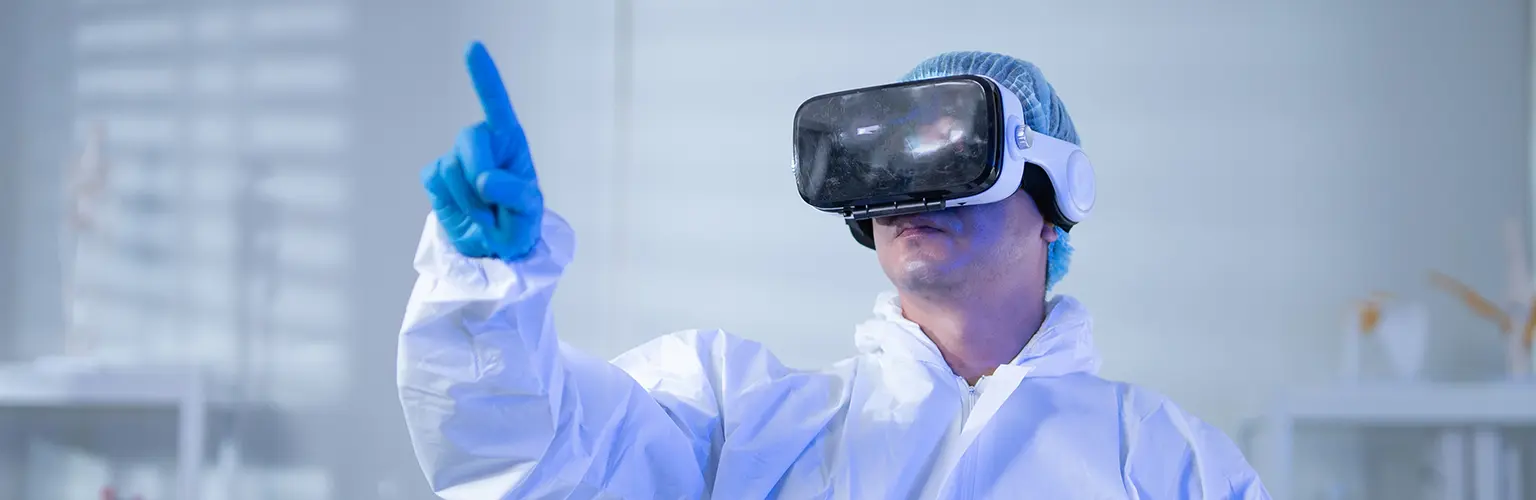
Using virtual reality to support healthcare practice
The Data Visualisation Observatory (DVO) is helping promote the use of Virtual Reality (VR) headsets in the healthcare industry through a unique collaboration with academics at the University of Manchester.
The partnership is being driven by Dr Gareth Kitchen, a consultant anaesthetist by training who is also a Clinical Senior Lecturer at the University. Dr Kitchen originally completed a PhD at the University and then went on to take a Development and Skills Enhancement Award focusing on industry and entrepreneurship.
Through this study he became interested in the potential of wearable technology to track patient information and observations in hospitals, and specifically how datasets could be superimposed into VR headsets to help clinicians.
Visualisation
As Dr Kitchen explains: “I started working with the DVO on developing specific visualisation tools which could be used in VR headsets to aid handover between doctors who work in critical care and are changing shifts.
"In particular, we looked at developing programmes which could help prioritise patient information. Using headsets the idea is that doctors can see everything they need to know about a specific patient and understand what may or may not have changed since they were last on shift. One of the big challenges with this idea is how to feed real-time data into the system and hence our exciting collaboration with the DVO to explore what was possible."
Augmented reality
Dr Qudamah Quboa from the DVO said all initial prototypes for the project were built by the DVO. “This is potentially a really big opportunity for the DVO. The medical sector has been one of the first to really explore the full potential of using VR headsets in the workplace and we can really help research this groundbreaking area.
"With a VR headset the user just sees exactly what is in the headset like with a computer game for instance. But this work also links with the growing use of augmented reality (AR) headsets where the user can see what is in front of them while information and data is then overlaid into your field of vision. Users can also flick between VR and AR as need be."
At an event AMBS invited healthcare professionals to a workshop to test out the prototypes, gather further data, and provide broader feedback on the project.
Added Dr Quboa: "At the event we had a mix of consultants, registrars and academics, and we received really positive feedback to our work."
The results of the project are currently being prepared as an academic manuscript and the team hope to use the experience, collaborative relationships, and data to apply for larger academic funding.
Other research
Dr Kitchen is also involved with other major research initiatives across the University. For instance, he is co-chief investigator on a major project which saw Manchester University NHS Foundation Trust (MFT) awarded almost £2.5m to investigate the effectiveness of new airways devices to transform care and outcomes for seriously ill patients in hospital Intensive Care Units (ICUs) who need help to breathe.
As he added: "My skillset is very much working at the interface of academia, healthcare and business. Right now, as our work with the DVO shows, there are a lot of very exciting opportunities and partnerships to explore."