
Using data visualisation to upskill the healthcare workforce
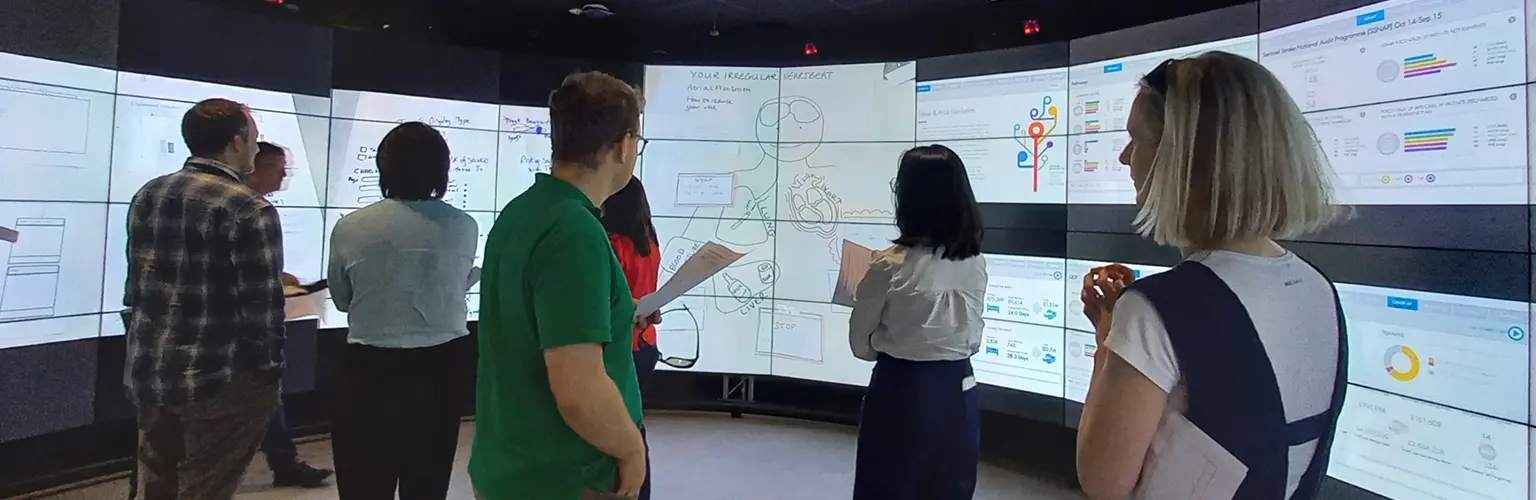
NHS staff have begun using the Data Visualisation Observatory (DVO) at AMBS as part of a blended learning course at the University of Manchester aimed at upskilling the healthcare workforce to prepare for digital transformation.
Data Visualisation and Communication is a core unit on the PGCert in the Clinical Data Science programme funded by NHS England. The course aims to provide students with a bridge between what they are doing clinically and the world of data science. Attendees all work in health and social care and range from doctors and nurses through to physiotherapists, pharmacists and lab technicians to name a few.
Exploring datasets
Alan Davies, Senior Lecturer in Health Data Sciences and Programme Director for Clinical Data Science, said the DVO was being used to show students how such a facility can be used to explore datasets, as well as providing a gallery for them to critique selected visualisations.
As he explained: “Given the name of the course unit, it made perfect sense for us to start using the DVO and we began using it last year with our first cohort of 30 students from across the country. This academic year we have 66 people on the course and in future we are hoping to have as many as 100.
"One of the great benefits of this course is that attendees can bring their own clinical challenges into the classroom and start thinking about how datasets can help them in their day-to-day work. One of the key aims here is building long-term impact and communities of practice. We have already had people who have completed the course contacting us and saying they are putting into practice what they have learnt, helping them to solve specific problems."
Dr Davies added that another benefit for it was getting in front of senior people in the NHS. "Right now, a lot of senior managers are working on real-world digital projects and the DVO is a great way to make these projects come alive. A virtual gallery like the DVO gets people walking around, gets them off their feet, and provides a novel way of facilitating group working. I am also really open to novel ways of how we might use the DVO more in the future."
Behavioural Research Laboratory
Health academics have also been using the Behavioural Research Laboratory (BRL) at AMBS as part of the same Clinical Data Science programme. The laboratory is used to show students how eye-tracking works, discuss how to interpret eye-tracking visualisation, and how students might use eye-tracking and other physiological methods to assess the usability of health apps, dashboards and web tools.
As Dr Davies added: "This is all about showing students another type of visualisation and getting them to think about another way of looking at how people visualise things. What many people don’t realise is that in the real world you can evaluate software and tools using eye tracking. So this is all about showing them the art of what is possible."
The Clinical Data Science programme can be taken over one year full-time, or two years part-time.
Find out further details about the programme on the University of Manchester website >>